We have the National Grid proposal for 3000K and 4000K lights!
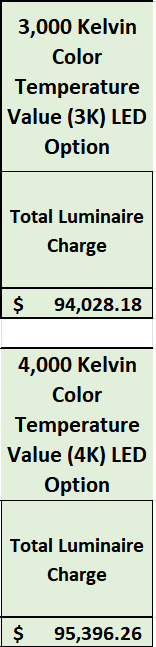
We submitted a public-document request and received the proposal. Contrary to some comments from town officials, the lights are not free! This extract from the National Grid spreadsheet shows that the town would pay $94,028 every year for the duration of the lease. This does not include the cost of electricity.
In 2022 Rockport contracted with Tanko Lighting to develop a plan for purchasing 2200K LED streetlights. Their recommendation would cost the Town about the same for four or five years, then no cost for the remaining life of the LEDs (about 20 years).
The Select Board has agreed to appoint a group to recommend the path forward (which we think is obvious). We eagerly await the appointment of this group.
Additional Background
13-minute WGBH/PBS video The Movement to Save Our Night Skies
Updates
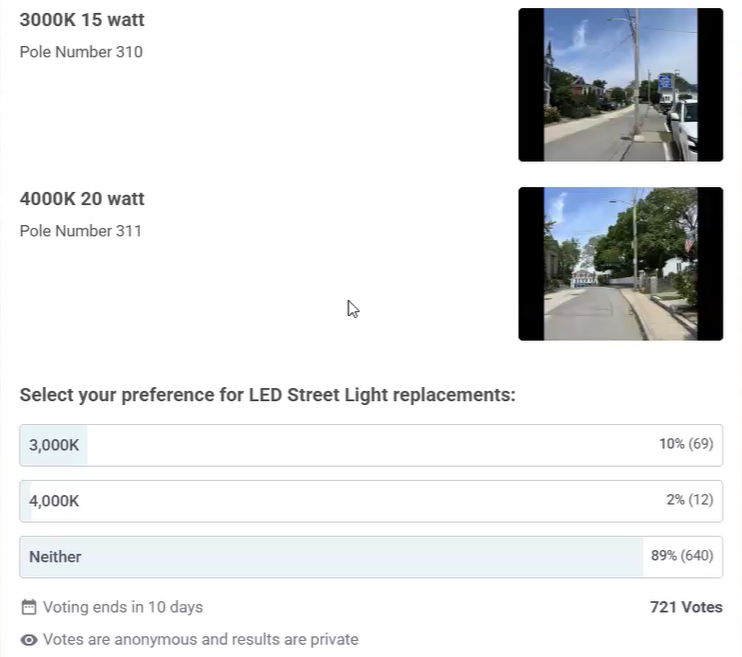
- Thanks to everyone who voted in the Town’s poll. Of more than 700 responses, 89% voted for “Neither”. On 16 June the Select Board, citing these results, voted 4-0 to decline the National Grid proposal.
- The American Medical Association (AMA) is about to recommend a maximum of 2,700K for streetlights. This is particularly important for the demographics of Rockport. This means the AMA will recommend against these National Grid lights.
- From the Massachusetts Medical Society in their 2025 Policy Compendium:
“The MMS recommends that outdoor lighting fixtures including streetlights, vehicle headlights, and outdoor lighting of homes and businesses use a color temperature of 2,700K or less and appropriate shielding.”
poll results at Select Board meeting
Important Poll
The Town put up an anonymous online poll to select new LED streetlights only from National Grid. The choices are:
- 3,000K like in Gloucester – bad for health, safety, and the environment
- 4,000K that towns get sued for installing – bluer and worse than 3,000K
- Neither – meaning not now or not from National Grid
The Rockport Civic League organizers recommend voting for the third option “Neither“. This could tell the Town to get 2200K LEDs. See the additional information below for why this is best for Rockport and for dark skies. Although the Select Board has already voted against the National Grid LEDs, the online poll claims to end on June 26th.
At the Rockport Library on 14 March 2026, experts and advocates presented Light Right at Night – information about dark-sky considerations for streetlights and other exterior lighting.
Bottom line: strong recommendations for 2200K streetlights
“…3000K is a Hobson’s choice. Don’t go there. 2200K will give you what you have now, the same color, unless you want downtown Rockport to look like the parking lot of a K-Mart…”
Footnote about Historical Lighting in Rockport
| Era | Primary Fuel Source | Estimated CCT |
|---|---|---|
| 1770s – 1840s | Whale Oil (Spermaceti) | 1800 K – 1900 K |
| 1830s – 1860s | Burning Fluid (Camphene) | 2000 K – 2100 K |
| 1860s – 1880s | Kerosene | 2100 K – 2200 K |
| 1870s – 1890s | Naphtha | 2000 K – 2400 K |
2200K LEDs would best match the existing and historical streetlights.
Additional Benefit for Safety in Rockport
2200K lighting illuminates the road better in foggy or snowy conditions because it reflects less off the fog or the snow (which is why some automotive fog lights are this color).
The forum was recorded but the video started late and had poor sound quality. The presenters recreated their presentations in the video below.
For more information about light pollution, visit DarkSky International at darksky.org.